Rings

Iron Cross Progression Pt.2

In this series, Carl breaks down one of the classic and favorite strength movements - the Iron Cross.  Following our POSITION-MOVEMENT-PURPOSE (PMP) framework, this next progression goes over the execution of the movement under no load, to emphasize the importance of maintaining torque throughout your movement between the start and finish positions.

Iron Cross Progression Pt.3

In this series, Carl breaks down one of the classic and favorite strength movements - the Iron Cross. In this video Carl explains how you can build up strength by changing your leg positions to add more load up on your arms and shoulders.

Iron Cross Progression Pt.4

In this series, Carl breaks down one of the classic and favorite strength movements - the Iron Cross.  In this video Carl demonstrates how to use the ring straps as assistance to help you scale the Iron Cross movements, by shortening your arm to reduce the load as you build up your strength.

Iron Cross Progression Pt.5

In this series, Carl breaks down one of the classic and favorite strength movements - the Iron Cross.  In this video Carl demonstrates how to use bands as an assistance to help you scale the Iron Cross movements, by partially supporting your body weight as you build strength throughout the entire movement.

Iron Cross Progression Pt.6

In this series, Carl breaks down one of the classic and favorite strength movements - the Iron Cross.  In this video Carl demonstrates how to add another joint and use a functional movement, such as the Bulgarian Dip, to train for the Iron Cross.

Kick Up to Handstand on Rings

... (details coming soon)

Kip Up to Support Progression Pt.1

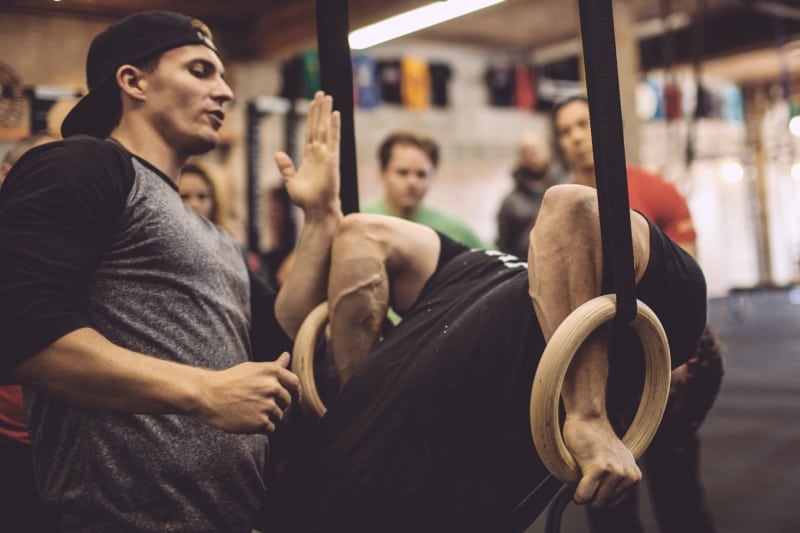
In this progression series, Coach Carl demonstrates how to change orientation on the Rings from an Inverted Hang to Support by using a Kip Up.  The ability to manage and change orientations is a key skill to have for skill transfer to other bodyweight movements, especially with minimal and unstable points of contacts like the Rings.

In the first video, Carl demonstrates the basic Kip Up drill on the Rings from an Inverted Hang.  The first progression is to Kip Up comfortably to a standing position without worrying about finishing in a support position, while still focusing on pulling the arms and elbows into the midline for a strong shoulder position to prep for the next drill.

Kip Up to Support Progression Pt.2

In this progression series, Coach Carl demonstrates how to change orientation on the Rings from an Inverted Hang to Support by using a Kip Up.  The ability to manage and change orientations is a key skill to have for skill transfer to other bodyweight movements, especially with minimal and unstable points of contacts like the Rings.

In this video, Carl moves onto the next step with the Kip Up drill to start receiving the finishing positioning in a partial dip by pressing the rings into the midline.  Work on developing skill by tapping your feet on the ground out of the kip and hopping up to support. The goal is to progress to not touching the ground at all, going from inverted hang, kip up to partial dip, then press up to support.

Kip Up to Support Progression Pt.3

In this progression series, Coach Carl demonstrates how to change orientation on the Rings from an Inverted Hang to Support by using a Kip Up.  The ability to manage and change orientations is a key skill to have for skill transfer to other bodyweight movements, especially with minimal and unstable points of contacts like the Rings.

In this video, Carl explains the last piece of the Kip Up to Support movement where you kip up to a support position with fully locked out arms, rather than pressing out from a partial dip.  Carl also talks about differences in grip, and variations in the finishing position - such as Kipping Up to an L-Seat.

Kipping Ring Row

  • Start in a Hollow Body position with feet on a box and hang with straight arms from the rings
  • With legs straight and tight body, thrust the hips up to the rings
  • As the body ascends, allow arms to bend to assist the movement

Note: This movement is not initiated with an arm pull, it done with a big hip drive up to the rings.

Pages